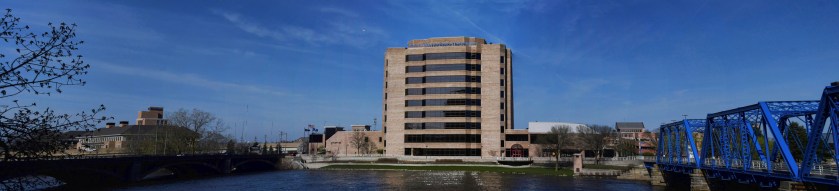
More than a decade after deciding not to follow recommendations contained in an engineering report, Grand Valley State University has spent more than $1.5 million to fill a void in the space below the Eberhard Center that could be the former site of the William T. Powers gypsum mine. The building has had lateral shifts and ground settlements.
Yet despite extensive internal communication between GVSU Facilities Head James Moyer, other university officials and the city of Grand Rapids, little if any, of this information has been shared with the GVSU community and the rest of the public.
An examination of more than 1,000 pages of documents obtained through a Freedom of Information Act to Grand Valley has revealed the following:
Soil boring testing disclosed gypsum deposits above and below the void which has caused some to speculate that the Eberhard Center was built over the former William T Powers Gypsum Mine that was capped and flooded around 1914.
Moyers wrote in an email that the University received a recommendation in 2005 to take a different approach toward dealing with the Eberhard Center, but Grand Valley chose not to follow it.
In 2017, the Eberhard Center was within two inches of settlement from being demolished, according to an email by Moyer.
The original budget to address the issues caused by the void was $1.3 million, but went over budget to $1,568,000.
Moyer said in an email that the Eberhard Center and nearby Lacks Park are safe and that the issues have been addressed.
Opened in 1988, the nine-story Eberhard Center is located on the West Side banks of the Grand River, just south of the Blue Bridge. A review of historic records revealed that in 1894 Grand Rapids pioneer, William T. Powers, dropped a mine shaft one hundred feet below the ground surface in the area that is now Lacks Park, just to the north of the Blue Bridge and mere yards from the Grand River.
He was looking to tap into the then booming Grand Rapids gypsum industry.The mine itself extended north and south from the shaft along the west bank and out under the Grand River. The mine operated off and on for less than a decade, closing in 1909. The mine was allowed to flood and was capped around 1914. Gypsum is water soluble and will dissolve over time..
When asked by email If the Eberhard Center was built on top of the mine, Moyer said “no”. In an August 2017 email by GVSU Associate Vice President for Human Resources Scott Richardson asked, “Think we are filling up a gypsum mine down there?” Richardson’s responds was In reference to a email stating that in one boring hole seven times the expected grout was used.
A series of voids have also been discovered under the Eberhard Center, according to the documents obtained through a Freedom of Information Act request.
“What is happening is that either mining or naturally the Grand River is dissolving the gypsum,” Said Dr. Stanley J. Vitton, an Affiliated Professor in Geological and Mining Engineering and Sciences at Michigan Tech University. “The big benefit to Grand Rapids is the fact that there was a shale layer over the gypsum which protected it from rapidly running water. That’s what dissolves it, but, again, putting mines in it isn’t the best thing for surface stability.”
In 1985, Materials Testing Consultants (MTC), a local Grand Rapids company performed a geotechnical investigation for the GVSU planned location of the Eberhard Center, according to a 2016 MTC report. Uncontrolled granular fill was encountered containing wood, brick, concrete and miscellaneous matter 10 to 20 feet below the former ground surface, the report said. Below the fill and organic soil, medium dense to dense granular soil with boulder and cobble was encountered underlain by weathered shale and gypsum bedrock of the Michigan Formation, the report said. In November 2004, GVSU noticed a horizontal opening that had developed between the tile floor and the east wall in front of the elevators of the Eberhard Center, the MTC report also stated.
Consequent to inspection, it was noted that the east foundation wall and two columns had shifted approximately a quarter inch towards the east. According to the report, settlement markers and crack monitors were placed in and around the Eberhard Center which indicated lateral movement to the east as well as ongoing settlement of the building.

A slope stability evaluation of the river bank was conducted which concluded that factors of safety against slope failure were relatively low for river elevations. Yet because of the relatively low factors of safety for the slope during high river level conditions, it was recommended in the report that improvements be made to raise the factor of safety to acceptable levels.
The report went on to indicate that between September and November 2005 Hardman Construction installed 62 H-piles and 44 tiebacks to reinsure the riverbank stability. H-Piles are dimensionally square structural beams that are driven in the ground for deep foundation applications. Micropiles were installed to underpin select existing building foundations supporting the east building wall where settlement had occurred Micropiles are high-performance, high-capacity drilled deep foundation elements typically between 5–12 inches in diameter that can extend to depths of 200 feet and achieve working loads of over 200 tons. Micropiles are comprised of high-strength steel casing, rebar and grout. Post-construction monitoring measured continued structure movement until February 2006 which then essentially stopped, indicating the structure had been stabilized after the transfer of load to the stabilization system.
In August 2015, settlement markers detected additional movement along the east wall in front of the elevators.
Monitoring after August 2015 indicated no lateral slope movement with continued settlement of the building, the report said. Considering the structure has experienced continued settlement at foundations which are supported by micropiles bearing on bedrock, concern over a potential deeper source of settlement necessitated an additional geotechnical investigation to evaluate the root cause of the settlement.
Following the report the University decided to take action. In an email dated December 12, 2016 Moyer asked MTC President Steve Elliott for a proposal.
“I need your proposal ASAP so that we can get the investigative work underway for any field work, we will be targeting March 5 -12, 2017,” Moyer wrote.
On Dec 23, 2016, at 8:46 AM, Todd Munger a project engineer from MTC wrote back to Moyer with MTC’s attached proposal to perform stability analyses of the east embankment as well as additional test drilling on-site to evaluate the potential cause of vertical movement.
The University soon learned that the work would be costly. In a series of emails on December 29, 2016 Moyer first sent an email to GVSU Associate Vice President for Human Resources Scott Richardson and several other GVSU staff members asked for approval of a proposed cost of $34,500.
At this point there had been continued movement at the Eberhard Center, records show.
“We need to do additional subsurface exploration to determine the cause and to determine a way to manage the movement,” Moyer wrote. “We have a proposed cost of $34,500. We would set the CMF account value at $40,000 to address any conditions encountered during the actual site work.”
This note prompted a concerned response from GVSU Vice President for University Relations Matt Mclogan.
“Uh oh,” he wrote. “Any guarantees still in force from the previous remediation?”
Moyer followed up with “not sure we can get a guarantee on this item. I do not think the University is in a good position.”
Moyer added that when the Eberhard had a problem a few years ago, records found where the soil engineers discussed a possible instability with the structure as proposed and made a recommendation about a very different foundation system. The University chose not to follow the engineer’s recommendation.
Moyer ended with,”we are in a bit of a race against the City and its flood protection program. And we are keeping the City informed about the Eberhard situation.”
MTC President Elliott declined to comment, citing a policy of not speaking about work with clients.
The communication between the City and Grand Valley continued in 2017. Moyer and then Grand Rapids City Engineer Mark DeClercq exchanged emails about the condition of the Eberhard Center.
In a March 8, 2017 email DeClercq sent to Moyer asserting that the issue with voids was not connected to floodwalls.
Moyer on March 10, 2017 writes to DeClercq, “Keeping you in the loop. As stated earlier, our situation with the building is not promising. We will be undertaking a project in May to address the situation being encountered at the Eberhard building.”
Moyer writes again to DeClercq on March 20, 2017 that he noticed the city was having an issue where Market Avenue had 2 inches of settlement without building load. He states in that email that “If we get 2 inches of settlement we will have to demolish the building.”

“We are looking at a significant project in the summer of 2017 at the building,” Moyer wrote.
It was a project that thus far has cost $1.6 million, records show. the original budget was slated for $1.3 million.
Two companies, Nicholson Construction Company and Hayward Baker Inc each submitted bids for the work. The contract was awarded to Hayward Baker Inc.
In short, Hayward Baker Inc proposed to perform low mobility grouting at the twelve locations to the depths specified and laid out by Materials Testing Consultants.
Materials Testing Consultants has recommended a grouting program along the West East edge of the Eberhard Center to fill existing voids and densify the overburden above the rock formation where rock voids were encountered approximately 85 feet below existing grade records show,
Mobilization on the project was planned for August 14, 2017, with drilling and grouting work to begin on the a week later.
On August 25, 2017 Spring Borchardt, Senior Project Manager for Hayward Baker, Inc sent an email to Todd Munger and James Moyer saying that the company pumped for three and half days on one grout hole using 286 cubic yards of grout, more than seven times the estimated volume on that location. Based on the contract documents, the over pour represented a substantial change to the work that was anticipated.
When asked about the over pour in a voicemail Borchard responded back in another voicemail that all questions should be directed to the university.
United States Geological Survey employee George Howell, in charge of the USGS Grand Rapids Grand River stream gaging station right next to the Eberhard Center witnessed most of the work. The company was dumping massive amounts of concrete down to fill some type of a void. With all of the work that they were doing they blocked access for him to service the gage for several weeks.
Howell said he asked the crew how long they would be doing the work, but they did not provide specific answers. Instead, they told him they had several voids to fill and did not know how deep they were. As a result, they couldn’t give him a timeframe. The workers told him they would pump concrete until it would not flow anymore, he said.
Records show that due to the high volume of grout placed within the initial twelve grout points, an additional 9 supplemental grout points were recommended and completed.
Grouting was completed on November 3, 2017 with a total of 2,324 cubic yards of grout placed within 21 grout points, MTC’s final report said, but this is not the end of the story.
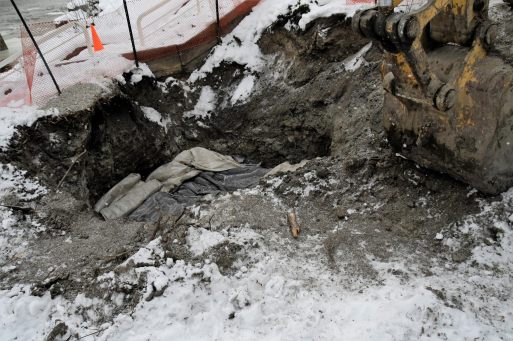
A surface sinkhole was detected in the Lacks Park that is just to the north of the Eberhard Center on December 7, 2017.A surface sinkhole was detected in the Lacks Park that is just to the north of the Eberhard Center on December 7, 2017.Reports showed that during the exploring and grouting work earlier the crews noticed that water and air was coming to the surface in Lacks Park north of the Blue Bridge. It appears that nothing was done until grounds workers noticed the sinkhole in Lacks Park.
Crews returned to the Eberhard Campus and “discovered” the location of the old Power’s mine shaft. Work was done in January, 2018 to repair the cap that had been placed over the shaft over a hundred years ago. The cost of that project is being added to the total repairs budget.
Moyer appeared prepared for the possibility that the work on the Eberhard Center would continue after his retirement at the end of March, 2018. On December 28, 2017, Munger sent Moyer with the attached summary report for the low‐mobility grouting work at Eberhard Center to be kept as records. The report summarizes the geotechnical investigation, stability results, recommendations and grouting completed.
Later that day Moyer forwarded the email to GVSU employees Pamela May and Pamela Hart that said, “Pam(s), Between the two of you, please have the attached document printed and bound with a hardcover (send it to a printer). Have a prominent label installed so that it is easily recognizable on the shelf. Also store the electronic copy. This will help the next person that has to deal with the Eberhard Center problem.”

 Media Works of John Rothwell