Lateral shifts and ground settlements GVSU spends over $1.6 million in repairs

33513490114_9bd4dda61d_k
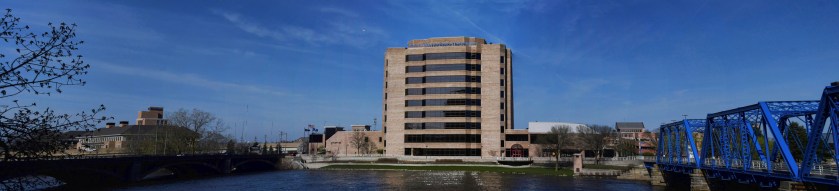
The Eberhard Center

More than a decade after deciding not to follow recommendations contained in an engineering report, Grand Valley State University has spent more than $1.5 million to fill a void in the space below the Eberhard Center that could be the former site of the William T. Powers gypsum mine. The building has had lateral shifts and ground settlements.

Yet despite extensive internal communication between GVSU Facilities Head James Moyer, other university officials and the city of Grand Rapids, little if any, of this information has been shared with the GVSU community and the rest of the public.

An examination of more than 1,000 pages of documents obtained through a Freedom of Information Act to Grand Valley has revealed the following:

Soil boring testing disclosed gypsum deposits above and below the void which has caused some to speculate that the Eberhard Center was built over the former William T Powers Gypsum Mine that was capped and flooded around 1914.

Moyers wrote in an email that the University received a recommendation in 2005 to take a different approach toward dealing with the Eberhard Center, but Grand Valley chose not to follow it.

In 2017, the Eberhard Center was within two inches of settlement from being demolished, according to an email by Moyer.

The original budget to address the issues caused by the void was $1.3 million, but went over budget to $1,568,000.

Moyer said in an email that the Eberhard Center and nearby Lacks Park are safe and that the issues have been addressed.


This slideshow requires JavaScript.

Opened in 1988, the nine-story Eberhard Center is located on the West Side banks of the Grand River, just south of the Blue Bridge. A review of historic records revealed that in 1894 Grand Rapids pioneer, William T. Powers, dropped a mine shaft one hundred feet below the ground surface in the area that is now Lacks Park, just to the north of the Blue Bridge and mere yards from the Grand River.

He was looking to tap into the then booming Grand Rapids gypsum industry.The mine itself extended north and south from the shaft along the west bank and out under the Grand River. The mine operated off and on for less than a decade, closing in 1909. The mine was allowed to flood and was capped around 1914. Gypsum is water soluble and will dissolve over time..

When asked by email If the Eberhard Center was built on top of the mine, Moyer said “no”. In an August 2017 email by GVSU Associate Vice President for Human Resources Scott Richardson asked, “Think we are filling up a gypsum mine down there?”  Richardson’s responds was In reference to a email stating that in one boring hole seven times the expected grout was used.

A series of voids have also been discovered under the Eberhard Center, according to the documents obtained through a Freedom of Information Act request.

“What is happening is that either mining or naturally the Grand River is dissolving the gypsum,” Said  Dr. Stanley J. Vitton, an Affiliated Professor in Geological and Mining Engineering and Sciences at Michigan Tech University. “The big benefit to Grand Rapids is the fact that there was a shale layer over the gypsum which protected it from rapidly running water. That’s what dissolves it, but, again, putting mines in it isn’t the best thing for surface stability.”

In 1985, Materials Testing Consultants (MTC), a local Grand Rapids company performed a geotechnical investigation for the GVSU planned location of the Eberhard Center, according to a 2016 MTC report. Uncontrolled granular fill was encountered containing wood, brick, concrete and miscellaneous matter 10 to 20 feet below the former ground surface, the report said.  Below the fill and organic soil, medium dense to dense granular soil with boulder and cobble was encountered underlain by weathered shale and gypsum bedrock of the Michigan Formation, the report said. In November 2004, GVSU noticed a horizontal opening that had developed between the tile floor and the east wall in front of the elevators of the Eberhard Center, the MTC report also stated.

Consequent to inspection, it was noted that the east foundation wall and two columns had shifted approximately a quarter inch towards the east. According to the report, settlement markers and crack monitors were placed in and around the Eberhard Center which indicated lateral movement to the east as well as ongoing settlement of the building.


IMG_0217
A monitor in the Eberhard Center April 2018


A slope stability evaluation of the river bank was conducted which concluded that factors of safety against slope failure were relatively low for river elevations. Yet  because of the relatively low factors of safety for the slope during high river level conditions, it was recommended in the report that improvements be made to raise the factor of safety to acceptable levels.

The report went on to indicate that between September and November 2005 Hardman Construction installed 62 H-piles and 44 tiebacks to reinsure the riverbank stability. H-Piles are dimensionally square structural beams that are driven in the ground for deep foundation applications. Micropiles were installed to underpin select existing building foundations supporting the east building wall where settlement had occurred Micropiles are high-performance, high-capacity drilled deep foundation elements typically between 5–12 inches in diameter that can extend to depths of 200 feet and achieve working loads of over 200 tons. Micropiles are comprised of high-strength steel casing, rebar and grout. Post-construction monitoring measured continued structure movement until February 2006 which then essentially stopped, indicating the structure had been stabilized after the transfer of load to the stabilization system.  

In August 2015, settlement markers detected additional movement along the east wall in front of the elevators.

Monitoring after August 2015 indicated no lateral slope movement with continued settlement of the building, the report said. Considering the structure has experienced continued settlement at foundations which are supported by micropiles bearing on bedrock, concern over a potential deeper source of settlement necessitated an additional geotechnical investigation to evaluate the root cause of the settlement.   

Following the report the University decided to take action. In an email dated December 12, 2016 Moyer asked MTC President Steve Elliott for a proposal.

“I need your proposal ASAP so that we can get the investigative work underway for any field work, we will be targeting March 5 -12, 2017,” Moyer wrote.

On Dec 23, 2016, at 8:46 AM, Todd Munger a project engineer from MTC wrote back to Moyer with MTC’s attached proposal to perform stability analyses of the east embankment as well as additional test drilling on-site to evaluate the potential cause of vertical movement.  

The University soon learned that the work would be costly. In a series of emails on December 29, 2016 Moyer first sent an email to GVSU Associate Vice President for Human Resources Scott Richardson and several other GVSU staff members asked for approval of a proposed cost of $34,500.  

At this point there had been continued movement at the Eberhard Center, records show.  

“We need to do additional subsurface exploration to determine the cause and to determine a way to manage the movement,” Moyer wrote.  “We have a proposed cost of $34,500. We would set the CMF account value at $40,000 to address any conditions encountered during the actual site work.”

This note prompted a concerned response from GVSU Vice President for University Relations Matt Mclogan.

“Uh oh,” he wrote. “Any guarantees still in force from the previous remediation?”

Moyer followed up with “not sure we can get a guarantee on this item. I do not think the University is in a good position.”

Moyer added that when the Eberhard had a problem a few years ago, records found where the soil engineers discussed a possible instability with the structure as proposed and made a recommendation about a very different foundation system. The University chose not to follow the engineer’s recommendation.  

Moyer ended with,”we are in a bit of a race against the City and its flood protection program. And we are keeping the City informed about the Eberhard situation.”

MTC President Elliott declined to comment, citing a policy of not speaking about work with clients.

The communication between the City and Grand Valley continued in 2017. Moyer and then Grand Rapids City Engineer Mark DeClercq exchanged emails about the condition of the Eberhard Center.

In a March 8, 2017 email DeClercq sent to Moyer asserting that the issue with voids was not connected to floodwalls.

Moyer on March 10, 2017 writes to DeClercq, “Keeping you in the loop. As stated earlier, our situation with the building is not promising.  We will be undertaking a project in May to address the situation being encountered at the Eberhard building.”

Moyer writes again to DeClercq on March 20, 2017 that he noticed the city was having an issue where Market Avenue had 2 inches of settlement without building load. He states in that email that “If we get 2 inches of settlement we will have to demolish the building.”

Screenshot8
A copy of an Email sent from James Moyer to Mark DeClercq

“We are looking at a significant project in the summer of 2017 at the building,” Moyer wrote.

It was a project that thus far has cost $1.6 million, records show. the original budget was slated for $1.3 million.

Two companies, Nicholson Construction Company and Hayward Baker Inc each submitted bids for the work. The contract was awarded to Hayward Baker Inc.

In short, Hayward Baker Inc proposed to perform low mobility grouting at the twelve locations to the depths specified and laid out by Materials Testing Consultants.  

Materials Testing Consultants has recommended a grouting program along the West East edge of the Eberhard Center to fill existing voids and densify the overburden above the rock formation where rock voids were encountered approximately 85 feet below existing grade records show,

Mobilization on the project was planned for August 14, 2017, with drilling and  grouting work to begin on the a week later.

On August 25, 2017 Spring Borchardt, Senior Project Manager for Hayward Baker, Inc sent an email to Todd Munger and James Moyer saying that the company pumped for three and half days on one grout hole using 286 cubic yards of grout, more than seven times the estimated volume on that location. Based on the contract documents, the over pour represented a substantial change to the work that was anticipated.

When asked about the over pour in a voicemail Borchard responded back in another voicemail that all questions should be directed to the university.

United States Geological Survey employee George Howell, in charge of the USGS Grand Rapids Grand River stream gaging station right next to the Eberhard Center witnessed most of the work. The company was dumping massive amounts of concrete down to fill some type of a void. With all of the work that they were doing they blocked access for him to service the gage for several weeks.

Howell said he asked the crew how long they would be doing the work, but they did not provide specific answers.  Instead, they told him they had several voids to fill and did not know how deep they were. As a result, they couldn’t give him a timeframe. The workers told him they would pump concrete until it would not flow anymore, he said.

Records show that due to the high volume of grout placed within the initial twelve grout points, an additional 9 supplemental grout points were recommended and completed.

Grouting was completed on November 3, 2017 with a total of 2,324 cubic yards of grout placed within 21 grout points, MTC’s final report said, but this is not the end of the story.

A surface sinkhole was detected in the Lacks Park that is just to the north of the Eberhard Center on December 7, 2017.A surface sinkhole was detected in the Lacks Park that is just to the north of the Eberhard Center on December 7, 2017.Reports showed that during the exploring and grouting work earlier the crews noticed that water and air was coming to the surface in Lacks Park north of the Blue Bridge. It appears that nothing was done until grounds workers noticed the sinkhole in Lacks Park.

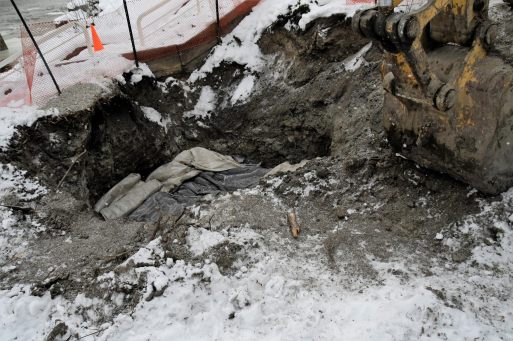
Crews returned to the Eberhard Campus and “discovered” the location of the old Power’s mine shaft. Work was done in January, 2018 to repair the cap that had been placed over the shaft  over a hundred years ago. The cost of that project is being added to the total repairs budget.
38669791245_e208fe424a_k
Work being done the opening of the Powers Mine Shaft January 2018/ John Rothwell

Moyer appeared prepared for the possibility that the work on the Eberhard Center would continue after his retirement at the end of March, 2018. On December 28, 2017, Munger sent Moyer with the attached summary report for the low‐mobility grouting work at Eberhard Center to be kept as records. The report summarizes the geotechnical investigation, stability results, recommendations and grouting completed.

Later that day Moyer forwarded the email to GVSU employees Pamela May and Pamela Hart that said, “Pam(s), Between the two of you, please have the attached document printed and bound with a hardcover (send it to a printer).  Have a prominent label installed so that it is easily recognizable on the shelf. Also store the electronic copy. This will help the next person that has to deal with the Eberhard Center problem.”


The commissioners’ night out took place at Oakdale Park Church in Grand Rapids’ third ward.

Grand Rapids City Commissioners hold their meeting at Oakdale Par Church on the city's southeast side

Grand Rapids City Commissioners hold their meeting at Oakdale Par Church on the city’s southeast side 

Moving the meeting out of Commission Chambers for the night, Grand Rapids City Commissioners brought City Hall to the third ward on Tuesday, March 6, 2018 for their commissioners night out. The meeting was held at Oakdale Park Christian Reformed Church, 961 Temple St. SE.

It is one of three that the City holds each year off-site with one in each ward of the city. The off-site meetings allow City Hall to come to the people.The City set up tables for representatives from various departments to be on hand to answer people’s questions before and during the meeting.

Second ward resident Paul V’Soske addressed the commission with concerns about an ordinance to rezone 3000 Monroe (The Veterans Home) to a special district-planned redeveloped district. The rezoning would be a start in the process of the VA building a new facility on property it owns along with the existing facility.

After a lengthy discussion with James Redford, Director of the Michigan Veterans Affairs Agency, on the timeline of the proposed new facility, along with design changes to accommodate the concerns of neighbors, commissioners voted 6-0 to approve the ordinance change.

V’Soske, who is the only adjacent property owner to the proposed project, has been a steward for thirty eight years of the undeveloped wooded area where the State wants to build a world-class veterans’ facility.

“All we are looking for is a good neighbor,” said V’Soske. “I am happy that Director Redford and his group are going to bring us together to start having the opportunity to engage.”

Commissioners also unanimously approved 6-0 to enter into a contract with Springsted Waters Inc. for the City Manager recruitment process.

City Commissioner Jon O’Connor was not present at the meeting.

The next City Commission meeting will be March 27, 2108 at 7 p.m. in the Commission Chambers on the 9th floor of City Hall located at 300 Monroe NW.


Photos from the Richard Spencer Protest at MSU

This slideshow requires JavaScript.


Even with a large police presence, white supremacists and anti-fascist protesters still managed to clash outside the Michigan State University  Pavilion for Agriculture and Livestock Education building where Richard Spencer was scheduled to speak on Monday March 5, 2018.

These are photos I took of the protest and clashes that occurred

Hundreds of West Michigan residents converged on DeVos Place to welcome in the Chinese New Year.

This slideshow requires JavaScript.

Photos from the 2018 Lunar New Year celebration

Hundreds of people gathered at Gillette Bridge in downtown Grand Rapids on Friday February 16, 2018, to welcome in the Lunar New Year. The Year of the Dog started with a bang with the lighting of 4,000 firecrackers.

The event being held in downtown Grand Rapids was the first time for the Chinese Association of West Michigan with the affair open to all West Michigan residents.

Participants followed a short parade that ended up at DeVos Place leading with a dragon which represents power, boldness, and excellence, including lions that symbolize strength, stability and superiority in the Chinese Culture. The creatures are meant to chase away evil spirits and welcome prosperous times during festive occasions.

Eight-hundred people purchased tickets to a sold out celebration, while many others were turned away at the door. The main auditorium where the show took place was standing-room only with people lining the walls to catch a glimpse of the performers.

Some food vendors ran out of certain items as they catered to the larger than expected crowd.

“I am happy that Grand Rapids is embracing this,” said Chinese Association of West Michigan committee member Ace Marasigan. “We will definitely need a bigger room next year.”

Inside the hall, Andrew Wu, 10, makes tea the way a friend of his mothers’ taught him while visiting his grandparents on a recent visit to China.

“It is very fun to make tea and tea taste very good,” Wu said.

The night was filled with events and performances that showed off not only Chinese traditions but also many Asian traditions.

“It was very good having a selection of so many nationalities,” said Herbert Welz, who attended with his wife and family friend. “The best thing is how you bring people together.”

The Chinese culture goes by the Lunar calendar. Lasting some fifteen days, the Chinese or Lunar New Year usually begins with the new moon that occurs between the end of January and early February and ends when the full moon arrives with the Festival of Lanterns.

The Chinese zodiac which is the included in the Chinese calendar contains twelve signs as the sun makes it path through the cosmos. Each year is represented by one of the twelve zodiac animals: the rat, ox, tiger, rabbit, dragon, snake, horse, sheep, monkey, rooster, dog and pig.

If you missed this year’s celebration plan on celebrating Lunar New Year next year on February 5, 2019 for the Year of the Pig.

Neighborhood organizations hold meetings informing residents about proposed zoning changes


Chi Benedict informs residents of the purposed zoning changes during a meeting held at  the West Grand Neighborhood Organization

Chi Benedict informs residents of the purposed zoning changes during a meeting held at the West Grand Neighborhood Organization

Neighborhood associations are worried that the city of Grand Rapids is pushing through new changes to the zoning ordinances without community engagement under the guise of creating more affordable housing. Meetings on Saturday, February 17, 2018 informed residents of the proposed changes to zoning ordinances that could take neighbor’s say out of the mix on future development in their own neighborhoods.

Don Lee, Executive Director of the Eastown Community Association, addressed residents from multiple south side neighborhoods during an early afternoon meeting at the Seymour Church. Lee unveiled a Powerpoint presentation allowing the concerned residents that attended a chance to see and discuss the zoning recommendations.

Don Lee, Executive Director of the Eastown Community Association, addressed residents from multiple south side neighborhoods.

Don Lee, Executive Director of the Eastown Community Association, addressed residents from multiple south side neighborhoods.

A capacity-filled space at the West Grand Neighborhood Organization was a much more heated meeting that took place later in the same day. Staff member Chi Benedict also presented a Powerpoint allowing the concerned residents the chance to and understand the plan. At times residents became vocal, speaking up and engaged in heated discussion with others in attendance.

View the West Grand powerpoint presentation here: https://johnrothwellblog.com/wp-content/uploads/2018/02/8b4d6-housingnow21recommendationswest.pdf

After the meeting, West Grand Neighborhood resident Margo Johnson and I continued our conversation regarding the potential changes and pitfalls.

“One of the frustrating things that I see happening at the planning commission level is that there isn’t a lot of training and the longevity, that history that goes into the process there are usually six standards when it comes to a planning decision and approval and we can go up there and show them that it does not meet those standards and it still gets approved; that’s a problem,” Johnson said.

Jim Davis, Executive Director of the Westside Collaborative and Planning Commission member, also took the time at the end of the meeting to meet with me.

“I want to just let everyone be reminded that the conversation that manifested surrounding the ‘Housing Now’ proposals, that is now before the city commission with amendments from the planning commission that the conversation record in the minutes and the video posted online will represent a heart beat for the affordable housing that we need to see in the city. that we’ve lost or that we need to add given our current needs,” Davis said.

“I am disappointed that so many people have misconstrued that as a land grab under the guise of affordability. No one went into this process hoping to give opportunity to people that have a bunch of money and property already. We were trying to eliminate the barriers and divides to the common neighbor to allow opportunities for people like me and my neighbors, to provide an additional unit for a family or neighbor who can’t afford the ridiculous rents we have right now.”

For those citizens who want their voice heard, neighborhood organizations are encouraging residents to attend the City Commission meeting at 7:00 p.m. February 20, 2018 in the Commission Chambers on the ninth floor of City Hall located at 300 Monroe NW.

The mystery lot of 269 Garfield SW


The house at 257 Richards SW once was located at 269 Garfield SW was moved due to a sinkhole forming at the Garfield address

The house at 257 Richards SW once was located at 269 Garfield SW was moved due to a sinkhole forming at the Garfield address


Imagine being awakened at 3 a.m. to the sounds of loud popping. The sounds you hear when there is a hail storm, but there is no hail storm happening. It is the sound of your house being sucked into a sinkhole.

Krystyna Czarnopys-Sweeney was twelve years old on the night of September 27,1965, when at 3:20 a.m. the family was awakened by that popping sound at the home on 269 Garfield SW.

“It was 3 o’clock in the morning and we heard this loud popping. Literally, it was like this huge large hail storm that woke us all up, so we all jumped out of bed,” said Czarnopys-Sweeney, speaking over the phone from her home in Nashville, Tennessee.

Czarnopys-Sweeney described what took place after that.

“My mother looked outside and then went to put her foot on the step and the steps caved in then she started screaming ‘Get out! Get out! Get out!’ We ran out the door. She grabbed my little sister out of the crib. “Everybody got out,” said Czarnopys-Sweeney.

“It was an experience I wouldn’t wish on anybody. It was the most frightening thing I have ever gone through.”

“Then we started hearing this loud pounding. You’re standing there watching your house as the sinkhole gets bigger and bigger and bigger and finally cave in. The entire basement was gone yet the structure of the house was still there. All of our belongings were in the basement…my Barbie dolls and all my dad’s tools. Everything was lost; everything sank into the ground and was gone.”

Arriving a decade before, Czarnopys-Sweeney’s father, Joseph, arrived from Poland with his three brothers. The four of them purchased four lots in the 200 block of Garfield SW to build homes.

The "Mystery Lot" at 269 Garfield SW

The “Mystery Lot” at 269 Garfield SW

Czarnopys-Sweeney feels the city was uncomfortable right from the beginning with the selling of the property.

“The land should have never have been built on. The topography was okay but underneath there they knew that something was wrong,” Czarnopys-Sweeney said. “There was some kind of stipulation with the purchases of the lots from the city.”

Neighbors called the lot the house was built on the Mystery Lot. Before being built on the area, kids would place piles of twigs, rocks and even toys on the lot and they would often be gone the next day according to Czarnopys-Sweeney.

Czarnopys-Sweeney remembers that when it rained the sewers would back up and their basement would flood.

“The insurance company said that the sinking was an act of God. No one received a penny of insurance from the incident. It was a year before the family saved up the money so they could move the house to a lot at 257 Richards NW.

During that year the hole was still open at Garfield, the sound of flowing water could be heard.

“You could hear the waters moving, so we thought it was an underground river,” said Czarnopys-Sweeney.

After the house was moved, the sinkhole was filled, it opened up again and filled in again. Joseph Czarnopys maintained the empty lot, cutting the grass every week and paying the taxes every year until his death in 1987, when the family deeded the property back to the city.

The city owned the property until it was sold to the Kent County Land Bank. It was then in the summer of 2017 real estate broker Joshua Schaub looked into purchasing and building a property on the lot.


The northeast prospective of the development that was planned for 269 Grafield SW

The northeast prospective of the development that was planned for 269 Grafield SW /Courtesy photo from a resident on Garfield SW

“I believe back in the 1970’s the previous home there just collapsed as a sinkhole ate away at the front of the foundation. I found this out at a neighborhood meeting as I was trying to get the community’s thoughts on my project. Some of the nearby neighbors had pictures and articles on the whole event. I eventually consulted with a geological digging company (don’t remember their name, I just Googled some) and they recommended I don’t build there because it could have a small risk of happening again. They stated you never know what the weight of the new home will do,” wrote Schaub in an email.

The Czarnopys believe that the city knew that they sold their family a bad property decades ago. With the recent request to build, what does the city know about this lot?

It was the neighbors who went to the Planning Commission when they heard of a development proposal in their neighborhood. Many asked why a house with the past experience of a sinkhole at that site should be allowed to be built on that location.

“The Planning Commission and Zoning don’t look at whether soils are suitable for development,” Grand Rapids City Planning Director Suzanne Schulz said. “That is the responsibility of the property owner to do their own due diligence.”

Are there other areas of the Westside in danger of sinking? This is the third article in a series exploring what it means to have an extensive network of mines and filled in wetlands in the same area where a lot of new business development is taking place on the Westside.

Residents complain they have to ask for backyard fire-pits,chickens, but developers could bypass public hearings


This multi-unit building going up on the corner of Lake Michigan and Seward NW tore down existing homes to be built

This multi-unit building going up on the corner of Lake Michigan and Seward NW tore down existing homes to be built


Neighborhood associations along with concerned citizens throughout the City of Grand Rapids are worried that under the guise of creating more affordable housing, suggested changes to zoning ordinances could take neighbor’s say out of the mix on future development in the neighborhoods.

During the January 25, 2018 Planning Commission meeting, the Commission recommended the City Commission pass changes that would mean people would not need to have a public hearing to get a zoning variance.

So-called “by right” developments would allow developers to build qualifying projects in some areas of the city without going to the planning commission, avoiding public hearings.

“With chickens or fire pits or building a fence up to the property line I have to ask my neighbors if I can do those things,” West Grand Neighborhood Association’s Annette Vandenberg said. “If I have to ask to do those minor things in my own backyard then I should have to ask to put a 800-square-foot dwelling unit in my backyard.”

Under the new by right development rule, it would mean developers do not have to put in for special land use, but they would still have to go to the planning commission. They would still have to go through the permit process but they do not have to seek neighborhood engagement any longer.

“The fear of the neighborhood associations, and frankly me, is that what this will result in is houses getting demolished,” Second Ward City Commissioner Ruth Kelly said. “Bought up by investors and then taken down.”

Kelly added that with some houses being in a deteriorated state some people may feel that it is a good thing to tear them down. Yet she worries about the people living in those houses.

“There are people living in those houses and where are they going to go once they are displaced, while they build new four to eight units?” questoined Kelly.

Marie Cimachowicz, Community Organizer at John Ball Area Neighbors, hears the horror stories of people in her area that are losing their homes in the name of growth.

“People are getting evicted and losing their homes … there is nothing affordable in the area,’ Cimachowicz said. “Single mothers cannot afford five hundred dollars a bedroom.”

According to the Planning Commission meeting minutes from January 25, 2018, City Planning Director Suzanne Schulz mentioned projects on Diamond and several off of Fourth Street where they are demolishing single family homes for multifamily units. “They are building them as pods where there is a duplex that is really four bedrooms for students in each bedroom. It isn’t that that will happen in all cases but it is something to be aware of because it is currently a practice,” Schulz is noted as saying.

The City Commission is likely to discuss the Planning Commission’s recommended changes at their next meeting.

“It is really important that we hear from the public,” Kelly said. “Zoning changes can have unintended consequences so I think that it is really important that we hear from the neighborhoods before we make any such changes.”

The next City Commission meeting will be February 20, 2018 in the Commission Chambers on the ninth floor of City Hall located at 300 Monroe NW.

Afternoon Fire on College NE


This slideshow requires JavaScript.

Grand Rapids, Mi— Firefighters battled flames at a house fire on Grand Rapids’ northeast side monday February 12, 2018.

The fire started around noon in 1500 block of College Avenue NE.

Several stations called to the scene. A large presence of firefighters worked to put out the fire, as well as to protect the neighboring home.

Firefighters could be could be seen tossing household items and belongings from an upstairs window.

It’s unclear what started the College street fire.

Grand Rapids City Commissioners vote for reset on City Manager search

This slideshow requires JavaScript.


On Tuesday night, February 6, 2018 a core number of issues commanded a majority of the meeting for Grand Rapids City Commissioners, ranging from the retirement of City Clerk Darlene O’Neal, a unanimously approved pedestrian-vehicle ordinance, the announcement of a reset for the City Manager search, to a highly contested property rezoning proposal.

Veering from the usual agenda, Mayor Rosalynn Bliss opened the meeting by honoring outgoing City Clerk Darlene O’Neal on her retirement after 33 years of public service.  O’Neal recognized her daughters as “deputy clerks” who supported her public service.  Deputy City Clerk Stephanie McMillen was appointed Acting Interim City Clerk.

Commissioners unanimously passed a new ordinance that requires vehicle operators to fully stop for pedestrians in uncontrolled crosswalks. The previous ordinance only required that motorists yield the right of way.  The worldwide campaign “Vision Zero” is aimed at lowering pedestrian vulnerability and was adopted in Grand Rapids in January.  The movement became more relevant after the vehicle-pedestrian related death of philanthropist and civic leader John Canepa on January 25, 2018.  Between 2012 and 2015 Kent County reported 790 pedestrian related crashes, the third highest in the state with 439 of those incidents occurring in Grand Rapids.

The City of Grand Rapids started working with a search firm in October to create a community profile candidate for the City Manager’s position with significant feedback from the community. In that process, over one thousand citizens and more than 300 city employees weighed in to create the community profile.  The search firm went out and actively posted and recruited for the position.  With sixty-one applicants, the City Commission saw a pool of five semi-finalists, then ultimately three finalists had final interviews on Tuesday afternoon.

First Ward Commissioner Jon O’Conner moved that the city reinstate the search for a City Manager and that they repost the job. Second Ward Commissioner Joe Jones seconded the motion, opening up a dialogue that lasted over twenty minutes between Commissioners on how and when to re-work the selection process. The end result was the board voting unanimously to re-initiate the search process.

“I want to apologize to the three candidates,” Commissioner David Allen said. “This is a process that we created and we should own it.”

Commissioner Jones added that  he was in favor of a “reset” in the search for a new City Manager.

“To me, re-initiating a search is telling of our commitment to wanting to finding the absolute best candidate,” Mayor Rosalynn Bliss said. “I have a lot of faith and have always had a lot of faith in this body and the collective wisdom around this table.”

The search will resume once the Commissioners have agreed on the process.

Many residents along with members of the Northeast Citizens Action Association raised concerns and voiced opposition against a proposed project at 843 Maryland Avenue NE and 2128 and 2129 Chesapeake Drive NE. The project would require a rezone from modern neighborhood low density residential to special district-planned redevelopment district where the developer wants to build 134 condominiums.

“Our board does not see a legal reason upon which we can oppose this project,” NECAA board member  Paul Greenwald read from a letter addressed on December 5, 2017 to the City Planning Commission. “We, however, ask for close scrutiny on this project as it moves forward.”

“Worcester would become a shortcut between Leonard and Maryland,” area resident Tim Nowak said. “We have kids and bicyclist along with neighborhood activities there.”

Tuesday’s meeting was broadcast on Facebook Live.  When contacted, a city official said that the city will be trying to broadcast all future meetings via Facebook Live. Click here to view this meeting.

The next City Commission meeting will be February 20, 2018  in the Commission Chambers on the 9th floor of City Hall located at 300 Monroe NW.

City Manager Greg Sundstrom attends his last city commission meeting


This slideshow requires JavaScript.


Tuesday night’s City Commission meeting, on January 30, 2018, had City Manager Greg Sundstrom Retire and Eric DeLong sworn in as interim manager. Citizens also talked about affordable housing and the search for a new city manager.


Exactly eight and a half years ago, to the day, Greg Sundstrom was sworn in as Grand Rapids City Manager. Tuesday night’s City Commission meeting was his last.

Sundstrom announced his retirement last August. He addressed the Commission for the final time at the start of the January 30, 2018 meeting. Thanking his wife Audrey Sundstrom, Sundstrom let her know that he would never be late coming home on a Tuesday evening, ever again. He went on to thank many of the people that he worked and served during his tenure with the city.  He concluded his speech by challenging the City Commission staff along with the entire community to focus upon their collective energy to eliminate poverty in Grand Rapids.

“Imagine a Grand Rapids where zip code does not eliminate opportunities and restrict your life choices,” Sundstrom said. “This is not beyond what city employees are capable of accomplishing. We can change outcome that can improve the lives of children and families across our city.”

Wishing Eric DeLong the best as interim manager, Sundstrom vacated his seat  allowing for the swearing in of DeLong until a permanent replacement can be found.

The meeting continued with an open discussion by members of the audience raising concerns about affordable housing within the city of Grand Rapids.

“People can’t get as job, hold a job if they don’t have housing,” Grand Rapids resident Martha Cooper said. “Saying that you cannot set a policy saying that sixty percent of AMI (Area Median Income) is really a failure of leadership and integrity”.  AMI, or Area Median Income, is an economic classification related to the median household income.

In public comments, Russell Olmsted asked the Commission if there was a way to get questions to the potential new city manager candidates in advance of the forum to consider and answer. The forum is to be held on February 5, 2018.

“It’s a great idea,” Mayor Rosalynn Bliss said. “We will follow up on that.”

The next City Commission meeting will be held February 6, 2018  in the Commission Chambers on the 9th floor of City Hall Located at 300 Monroe NW.